Alex Thompson | July 9 , 2026

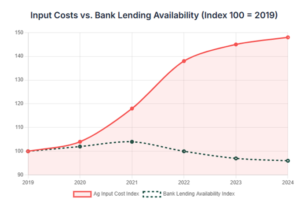
Australian agricultural producers are facing a squeeze. Input costs are elevating and continuing to rise, while traditional banking capital retreats. Yet, global food demand remains highly inelastic. This divergence creates a unique entry point for private credit and equity to generate premium yields supported by essential real assets.
The Funding Gap
The modern Australian farmer operates a highly capital-intensive enterprise. Over the last five years, macroeconomic shocks have driven essential input costs (fertilizer, diesel, machinery, and labour) to record highs. At the same time, increasing regulatory burdens, capital requirements, and changing risk appetites have forced traditional domestic banks to tighten leverage ratios (LVRs) and restrict agricultural lending growth, leaving productive operators starved for operational and expansion capital.
Inelastic Global Demand
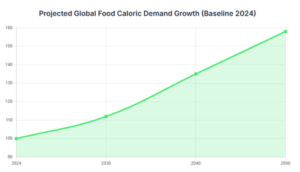
While input markets are volatile and credit markets are cyclical, the demand for high-quality, safe caloric intake is absolute. Australia exports over 70% of its agricultural production. As the global middle class expands, particularly in the Asia-Pacific region, the demand for Australia’s premium agricultural exports may be considered structurally underwritten. Food production is an essential utility, making the underlying assets highly resilient to broader economic downturns.
The Private Capital Mechanics
The dislocation between essential production needs and traditional banking constraints establishes a favourable environment for private capital. Private credit can command premium interest rates while securing loans against appreciating, tangible land assets. Furthermore, private equity can consolidate fragmented holdings, inject ag-tech efficiencies, and realize significant margin expansions.
Top 3 Beneficiaries
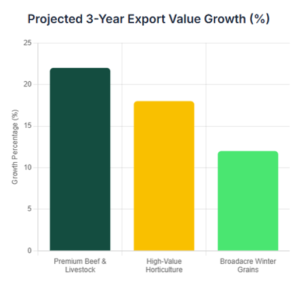
Not all agricultural sub-sectors will respond equally to private capital. Over the next 36 months, three specific Australian commodities may present the highest asymmetrical risk-reward profiles due to their specific export dynamics, structural capital needs, and capacity for technological integration.
Highest Priority
Australia’s disease-free status commands massive premiums in Asian markets. Capital is required for feedlot expansion, vertically integrated supply chains, and genetics to meet the surge in demand for traceable, grass-fed, and premium Wagyu beef.
High Margin
Tree nuts (macadamias, almonds) and premium table grapes. These are highly capital-intensive to establish (long lead times to maturity) making them poorly suited to short-term bank debt, perfectly aligning with patient private equity seeking massive eventual cash flows.
Scale Essential
Wheat and canola. Global supply shocks (geopolitics, climate events in competing hemispheres) have cemented Australia as the reliable supplier. Private capital is needed for massive land consolidation and precision ag-machinery to drive down per-hectare operating costs.
iPartners is proud to support Australia’s premier primary industry field days.
As the agricultural landscape evolves, so do the opportunities to grow and protect your wealth. This year, iPartners is heading to Gunnedah, and we invite you to step away from the machinery and into the world of alternative investments.
Find us at AgQuip from August 18–20. Secure your seat for lunch by visiting the website or stopping by our site to speak with the team.
iPartners: Empowering Investors through Alternatives.
iPartners Agricultural Portfolio Examples

|
 |
 |
| Feature | Tasmanian Dairy | Australian Livestock | Murray Cod |
| Asset Class | Private Equity (Agribusiness / Dairy) | Asset Backed (Agricultural Trade Finance) | Aquaculture |
| Security Type | Equity | Senior Notes (Class A Notes) with 35% loss protection | Corporate Loan (Secured via General Security Agreement & 1st ranking mortgages) |
| Target Return / Profile | 12% to 15% IRR p.a. (Target pre-tax return net of fees) | 1M BBSW + 6.00% p.a. (~9.02% p.a. floating at issue) | 1M BBSW + 9.00% p.a. (~13.29% p.a. floating at issue) |
| Expected Term / Maturity | 7 years (Target liquidity event July 2030, option to extend to 10 years) | Short-term (Expected August 2023, with options to extend availability period) | 18 Months (Early Call Date; Legal Maturity at 24 months with a 4% step-up if not called) |
| Underlying Assets / Strategy | Acquisition and developmental expansion of Tasmanian dairy/grazing land properties (Part Norley and Dunrobin) and water rights. | Trade finance portfolio advanced to livestock agents, backed by cattle and sheep ownership. | Sustainable Murray Cod biomass expansion, aquaculture ponds, and water access licenses in NSW. |


