Andrew Baume | August 20 , 2026

The RBA’s three rate hikes in the current tightening cycle, combined with Federal Budget measures, have severely dampened the housing market. The longstanding disconnect between mark-to-market valuations and the reality on the ground for buyers and sellers has rarely been starker. Although these rate hikes may not have fully tamed inflation yet, they are undeniably reshaping the property market, and real estate agents are seeing far fewer transactions than they are used to.
As few property owners currently require immediate liquidity, transaction volumes have dropped significantly as owners choose not to sell at prices below their expectations. In reality, the headlines screaming “disaster ahead” affect very few homeowners in a cashflow sense. These alarmist takes have most impact through the “wealth effect” which occurs when we feel less well off. Typically, that means spending is reduced and savings increased (often by greater payments than required into mortgages each month).
The housing finance market can become less rather than more risky with less money owing as long as the extra savings do not lead to a widespread economic contraction. The RBA is keeping a close eye on the labour market, which has weakened a little but remains robust and not likely to fall away in the near term. On that basis, markets are pricing in negligible changes in cash rates for the next year.
Consumption has actually remained robust and June figures released earlier this month show spending in positive territory and above trend. This is despite the widely published Melbourne Institute Westpac Consumer Sentiment being sharply lower in June. It demonstrates that headlines are often pushing a different story than reality and indeed the sentiment survey has risen in the most recent release as the prospect of more rate hikes recedes.
The past few months have seen confidence in Private Markets ebbing despite default rates remaining well below averages and for most sectors below expectations. One feature of private debt markets is that defaults are not only expected, they are an integral part of the lending process.
With no defaults investors would earn no returns. The critical question is not “are there defaults”, it should be “are there unexpected defaults and how are they being managed?”
To put the current market conditions in context, the major ratings agencies – who have millions of data points and hundreds of thousands of borrower records to compare – are expecting default rates to reduce in 2026 and into 2027.
Leveraged loan default rates are projected by Fitch to finish the year around 4.5%–5%, while high-yield (HY) default rates are anticipated to hover between 2.5%–3%, showing a modest easing from previous peaks. The headlines are flagging a crisis to come while the experts are saying the peak (which was substantially lower than peaks in the past) is over.
Some investors who have been influenced by the static surrounding the segment have chosen to retreat from credit. The critical difference between credit and shares, for example, is that lenders get repaid before shareholders see any return of capital. A credit crisis, were it to occur, would have an incredibly adverse effect on global equities.
The flow in markets remains strongly positive. In Australia alone, Calastone estimates that managed funds had net inflows of over $35 billion in 2025, Morningstar reports ETFs were up by $60 billion and APRA-regulated superannuation funds had net inflows of $72 billion. The fixed income segment was the big riser in managed funds with nearly $17 billion flowing to the segment.
Given these strong numbers, the equity market’s robustness is less puzzling but the retreat from Private Debt has clearly been driven by unfamiliarity rather than the returns of the sector.
It is quite likely that the more sophisticated investors who are tilting to fixed income will recognise the higher ranking of debt over equity in the event of market disruption. The traditional fixed rate fixed rate bond market has earned a total return of only 0.4% per annum over the past five years. A debt investment earning the cash rate plus 4.5% would have outperformed Australian Equities over those five years with a tiny fraction of the volatility.
Enhancements to reporting and disclosure should help to rebuild confidence across the sector. Asset allocators who understand the continuum of debt and equity should continue to deploy given the attractive returns given the true risk taken.
The aim of the Federal Budget measures is to increase the ability of household formation and allowing first homeowners some more choice. Presently the opposite has occurred with housing stock turnover decreasing, and the grandfathering of negative gearing slowing investors’ desire to turn over their investments because the ability to negatively gear a new purchase is now limited only to new-build accommodation.
Commercial property may be a beneficiary with investors switching from a capital gains-driven profile to one driven by rentals and cap rates.
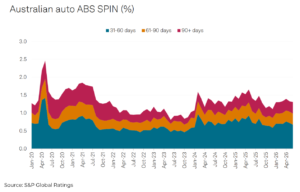
The cumulative effect of three rate hikes was beginning to be reflected in auto arrears, which have now plateaued in June after falling for the previous few months. These data still show a very resilient consumer and are lower than the levels from 12 months ago, before the RBA began their rate hike cycle.
The Standard and Poor’s Australian auto ABS SPIN comprises closed pool transactions in which the receivables in the underlying asset pools are secured 100% by motor vehicles or mixed pools in which most are backed by motor vehicles. The indices identify the proportion of loans 31-60 days, 61-90 days, and 90-plus days in arrears. S&P Global Ratings calculates the SPIN monthly, using information provided by the issuers of ABS transactions.
While indicators like unemployment, consumer spending and borrower behaviour remain strong, the prospects for the economy continuing to deliver gradual but slow growth are in place. As always, perceptions of weakness (particularly related to housing markets) and the true real economy can diverge. The bigger risk seems to be remaining under invested.


