Travis Miller | April 22 , 2026

Property as a Strategic Alternative Asset

Property as a Strategic Alternative Asset
INTRO

For many Australian investors, “property” evokes a familiar image: a suburban house with a backyard and a 30-year mortgage. While residential real estate is a cornerstone of national wealth, viewing property through the lens of an alternative investment opens the door to a diverse asset class. Property is capable of providing reliable returns, income stability, and a robust hedge against inflation.

The property asset class represents a sophisticated spectrum of risk and reward, understanding where you sit on this spectrum requires a deep dive into property sectors, capital structures, and the specific vehicles investors use to access them.

Property by Sector

Property investment is generally categorised by the underlying utility of the land and buildings.

  • Residential: The most familiar sector, encompassing houses, apartments, and Build-to-Rent (BTR) projects. Its returns are correlated with population growth trends and consumer sentiment.
  • Commercial: Includes office spaces, retail shopping centres, and specialised assets like childcare or medical centres. Returns are heavily linked to lease terms and tenant quality.
  • Industrial: This includes warehouses, logistics hubs, and distribution centres. The buildings tend to be on large pieces of land that can have the potential to be re-purposed or re-zoned down the track.
  • Agricultural: Farmland and primary production assets. This is one of the most common commodities in Australia, and a fast-growing asset class for investors.
  • Aggregation: This involves buying multiple smaller assets (e.g., several pubs and hotels) to create a portfolio that is more valuable than the sum of its parts, often aiming for an exit to an institutional buyer.
  • REITs (Real Estate Investment Trusts): These allow investors to buy shares in a professionally managed portfolio of properties, providing the liquidity that direct property lacks.

Property Options

  • An option gives an investor the right (but not the obligation) to buy a property at a set price in the future.
  • Leverage in Options: Because you only pay a small “option fee” to control a large asset, the leverage can be immense. If the land is rezoned and value triples, your return on the small fee is exponential. Conversely, if the project isn’t viable, you lose 100% of the option fee.
The Capital Structure: Understanding Property Debt

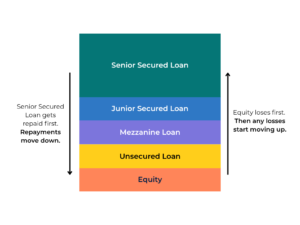
In any property transaction, there is a “capital stack.” Where you sit in the stack determines your priority for repayment and your level of risk.

Senior Secured Loans (First Mortgage)

The safest part of the stack. These lenders have the first claim on the asset if the borrower defaults.

  • Land Banks: Loans secured against vacant or pre-developed land held for future use.
  • Development Loans: Funding specifically for the construction phase, usually drawn down in stages.
  • High LVR Loans: Loans with a high Loan-to-Value Ratio, meaning the borrower has less of a down payment, increasing the lender’s risk and therefore typically increasing interest.
  • Low LVR Loans: Loans with a low Loan-to-Value Ratio, are the lowest risk form of senior property debt.  Given the low risk nature of this type of lend, it would be expected to be funded by a bank at a low or competitive interest rate.

Junior & Mezzanine Debt

  • Junior Secured: Sits behind the senior lender. If the property is sold, the senior lender is paid in full before the junior lender receives a cent.
  • Mezzanine Loans: Often used to bridge the gap between the senior loan and the developer’s equity. It carries higher interest rates (often 10–15%+) to compensate for the higher risk of being lower in the debt stack.


Unsecured Loans

These have no claim on the physical property. They rely entirely on the borrower’s cash flow or corporate guarantee, making them the highest-risk form of debt.

The capital structure can be seen visually below.
Property Equity

Equity represents ownership. However, the risk profile changes dramatically depending on the lifecycle of the asset.

Project-Based Development Equity

This involves funding the construction of new assets. It offers the highest potential returns but carries significant delivery risk, including planning approvals, construction cost blowouts, and market absorption risk (that no one buys/rents the finished product).

Equity in Established Assets

Investing in a “de-risked,” tenanted asset, like a fully occupied shopping center or a childcare hub, is focused on yield. The primary risks here are vacancy (tenant default) and cap rate expansion (where the property value drops because market interest rates rise, making the yield return less attractive relative to other potential investments).


Weighing Up Risk and Return
The relationship between interest rates and property is fundamental in weighing up risk and return. When interest rates are low, property debt is cheap, which typically drives asset prices up. However, as rates rise, the cost of servicing property debt increases, which can squeeze profit margins for developers and lead to falling valuations for established assets. By understanding these sectors and structures, investors can move beyond simple home ownership and start to build an institutional-like portfolio.

Please note private credit investments have a number of risks that are often unique including (but not limited to) illiquidity risk, credit risk, market risk, interest rate risk, legal risk, regulatory risk and tax risk.  You should read the relevant disclosure document and the full list of risks in it before making any decision to invest.
