Andrew Baume | September 16 , 2026

It has been an incredibly news-heavy month for both private debt and bond markets. Persistent inflation and government policy are cruelling house prices. Highly concentrated lenders have suffered badly through a single borrower defaulting. Being aware that risks may be rising is important, but being uninvested for long periods of time is usually not the best option unless timing is accurate. Investments offer returns to offset losses and without occasional upticks in risk, returns would suffer. Increasing risk does not have to equate to losses.
Although there has been no movement in the cash rate from the RBA since May, we are seeing disturbing economic data and stubborn inflation. The narrow path for the central bank is not getting wider and higher-than-expected inflation and GDP growth have brought market pricing back from neutral to at least one more hike expected.
This threat of higher rates comes despite sometimes alarmist headlines suggesting house prices, which are already under pressure, may head lower by as much as 15%. Although the unemployment rate in Australia has been well below the average for this century it is creeping higher as the impact of higher costs (including interest rates) work their way through the economy. Despite the weakening labour market, consumer spending has hardly reacted whilst at the same time sentiment is weak.
These conflicting economic signals are exacerbated by geopolitical conflicts that are unresolved. Significantly higher bond yields in the US have not fed through to asset prices as directly as might have been expected.
Our preference for floating rate and short duration assets remains with the composite bond index delivering a negative return for Australian Fixed Rate Bond investors in August.
The collapse of a major borrower in the private credit market has grabbed headlines partly because lending to property developers had become the key asset group for many funds. While the tide raises all boats this approach has been acceptable to investors with good returns from the segment. Delays in construction and higher input costs were often met with more money borrowed against “as if completed” valuations.
An “as if completed” valuation is a prediction of the value of the improvements being made at the property at some time in the future. It does not reflect where the property with its current work (or potentially vacant land) could be sold in today’s market.
One of the key principles of creating investment pools is diversification – the old trope of “don’t put all your eggs in the one basket.” Lending to a single market segment and then having awkward concentrations to a cyclically exposed sub-segment becomes a problem when the tide turns.
Because some Funds and Fund Managers in the private credit sector have had very high weightings to property, and within that to construction, the headlines have implied that all private credit is excessively exposed to property. In reality this questionable lending strategy is not a feature of a well-balanced pool of private credit assets and yet confidence in the segment may remain low for some time.
This lower confidence has already fed its way into the broader private credit market where new originations are able to extract better terms from borrowers that are not at all connected to the property market. We expect returns in the segment to deliver enhanced returns for investors in these more diversified pools.
Interestingly the recent collapse of Bathla is for similar amounts of debt owed by the Toplace Group, whose principal fled overseas rather than face the consequences for behaviour that is now subject to criminal indictment. By the standard of that collapse and many others in the construction business over the years, the Bathla situation is marked by over leverage rather than systematic fraud.
Warren Buffett is known as the Sage of Omaha and one of his most memorable quotes is “be fearful when others are greedy and greedy when others are fearful.”
Budget changes have had a significant impact on house prices despite government suggesting the weakness is just a coincidence. Lower house prices are often accompanied by lack of consumer confidence and in this instance the spectre of the higher cash rates predicted by the market. When compounded by the relentless headlines focused on private debt, the market has significantly lost its lustre in the short term.
When a deeper analysis is done, it is clear that the Australian balance sheet is in robust condition. Despite the headline amount of debt owed by government, it remains below 35% of GDP and Australia remains one of only 9 countries in the world with AAA ratings from Moody’s, Fitch and S&P Ratings. The average household balance sheet has improved markedly in the past 10 years. Debt to income has come down from its peaks but households are much richer.
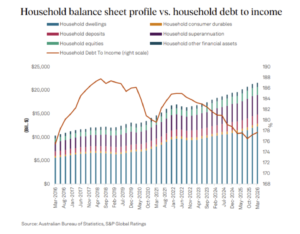
There is fear of spiralling lower house prices following government and central bank intervention which is keeping investment money on the sidelines. According to Deutsche Bank, the current downturn is already deep on an historical basis and they question how much further the correction can go whilst there is still a shortfall of accommodation.
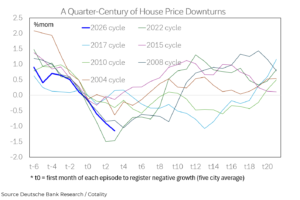
The above chart shows that the current fall in the market is the second steepest and only outpaced by the rate hike cycle losses beginning in 2022. In the chart, T0 represents the month where house prices first went down rather than up for each of the cycles. Data to the left show how fast prices were rising before they began to fall. Deutsche Bank predicts that in this cycle house prices will again begin to rise in about 6 months’ time and the average peak to trough loss will be held at -5.5%.
Standard and Poor’s tracks the arrears rates in auto financing funded through securitisation. Their data show that arrears for auto financing are currently below the 6-year average and well below peak levels. These data are an excellent proxy for the capacity of both the Australian consumer and Small Businesses to meet their financing obligations.
There has been a rationing of capital into private debt which is a sharp turnaround from the flows of the last few years. Investors are sensibly wary of backing lenders with overly concentrated exposures (particularly to construction finance.) Those lenders are only a subset of the whole market which is experiencing liquidity rationing and will perversely swing the negotiating power back towards the lenders after years of borrower ascendancy. In this market, Buffett principles suggest deploying more to the segment, especially to managers who are able to originate their own deals with more lender-friendly terms whilst retaining superior returns.
Investors who understand the medium-term nature of accrual income are well-positioned to benefit as widening credit spreads translate into higher fund returns. Managers are actively tightening loan covenants to ensure stronger intervention rights should borrower circumstances change.
While spreads may widen, long-term performance hinges on assembling a portfolio insulated from severe credit events. Multi-sector diversification across varied borrower profiles provides a far better buffer against simultaneous stress than concentrated, sector-specific strategies.
Originating and structuring capability remains a crucial differentiator. Rather than acting as price-takers in broad syndication markets, active managers can set bespoke terms. Combining this with shorter loan tenors allows lenders to re-price risk and refresh loan conditions more frequently.
While analysts closely monitor bank disclosures and reserves, macro data outside the troubled construction sector remains benign. Crucially, because private credit operates with minimal bank provided leverage, any localised stress will remain contained, preventing the systemic spillover often predicted by headlines.
Contagion in financial assets requires rafts of asset selling forced on owners by their financiers. As most private credit does not have this pressure – and any leverage is extremely modest where it does exist – the reward on offer in the shape of interest charged to the borrowers will remediate portfolios just as it has been doing since modern banking began in Italy in 1472.
The cost of being fearful is to miss the opportunity to gather enhanced returns from one of the world’s oldest and most successful investment opportunities.


