Andrew Baume | October 26 , 2026

Primary markets have set records over the past 2 months with borrowers like Alphabet (Google) tapping the Australian capital markets for $5.5 Billion and Westpac selling down their RAMS portfolio through a $15 billion plus ABS. ABS and RMBS issuance are also well ahead of historical volumes even when excluding the RAMS deal. All this at a time where interest rates are on the way higher and negative press on credit has never been more trendy.
As this mammoth issuance is digested in the higher rating grades, other borrowers are seeing the beginnings of exhaustion. Those who invest via index are the ultimate owners of any asset that fits the box. Debt is a key plank in capital formation. Crowding out by offshore borrowers and massive mortgage backed transactions means the situation for the borrowers who actually drive the Australian economy has become less friendly.
The problems manifesting in a subset of private debt, namely construction finance, has knocked the wind out of the sails of what had been a growing investment allocation. Many commentaries fail to distinguish between the troubled subset and private credit as a whole. The discussion around valuations has broadened from the area of real concern which is construction sites or vacant land before the finished product is available for sale to other collateral types that bear none of that risk.
One factor that led to the current circumstances is the stretch for returns that drove credit funds to allocate heavily to the more risky construction segment. In cutting through the noise, investors would do well to keep Warrant Buffet’s classic market commentary at front of mind: “Be fearful when others are greedy, and greedy when others are fearful.”
This market is in the midst of a reset after several years of borrower friendly terms. We would expect to see a mixture of higher pricing and better lenders’ covenants in recent months. Coupled with higher base rates as the RBA continues the tightening cycle is an almost perfect match for the Buffet style of investor.
Higher inflation and a still robust employment market gave the RBA no choice but to hike at their late September meeting. Failing to do so would have run the gauntlet of market participants projecting that they were “soft” on inflation. The prospect of fiscal deficits as far as the eye can see is unnerving international bond markets with curves steepening in the US and getting to a critical point in France. Maintaining the discipline and forcing pain to avoid a worse outcome in the future was demanded by all (except the Treasurer it seems). The absence of any true fiscal restraint means the Board is hoping unemployment weakens quickly and the heat comes out of the price impulse so that further hikes are not required. Late September data showed unemployment higher which is a callous sign that higher rates are beginning to have some effect
The market is now pricing in at least one more rate hike which would take the cash rate to over 4.85% and bond markets are struggling with this projection.
From a borrower’s market overwhelmed with new money in 2025 the recent headlines have turned the tide in lenders’ favour. Investment grade bonds and borrowers remain solid but unrated or non-Investment grade borrowers are seeing higher credit margins being applied which is often accompanied by stronger lenders’ covenants.
This two-tiered market exists because lending to unrated borrowers requires specialised expertise and focus. Data can be difficult to extract and is rarely presented in the standardised formats required by rating agencies. Essential manager skills include building genuinely diversified portfolios and avoiding excessive exposure to volatile sectors like property development, where underlying assets must be transformed before lenders can be repaid. Over the coming quarters, managers with these capabilities are expected to outperform those who relied heavily on high-risk property development to chase yield.
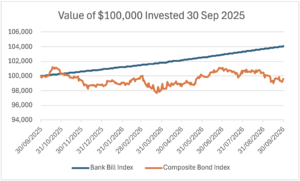
Investors who are risk adverse are often looking to fixed rate bond markets to provide a safe haven. That has not been the case in Australia, in the past 12 months the widely referenced Composite Bond Index has delivered a negative return for investors of about -0.4% with some big swings along the way. Over the same timeframe the Bank Bill Index has grown by over 4% steady as she goes. This 4.5% gap widens even further if the investment includes some highly rated bonds (which are included in the composite index.) In fact the table below shows that owning fixed rate bonds has consistently underperformed floating rates.
 Source: Bloomberg
Across all these holding periods, owning fixed-rate assets tied to the index yielded inferior returns. While fixed-rate bond investors will eventually be proven right when rates fall, relying on market timing transforms fixed income from a steady savings vehicle into a trading strategy. By contrast, floating-rate and short-maturity assets offer greater stability during volatile periods. As the chart below illustrates, the Composite Bond Index delivered only modest results while subjecting investors to significant price volatility.
 Source: Bloomberg
Investors in Private Credit funds who reinvest their distributions have earned a further spread over the Bank Bill Index total return with some variation between managers. Despite some funds having put a hold on redemptions, the segment has delivered positive returns and patient investors will participate in any recovery where those exiting cannot. For perspective, the 1 year total return for the ASX All Ordinaries was a meagre 1.4%
Investors have questioned whether the Private Debt market will survive the fall of Bathla and adjustment to property valuations. As a critical plank in capital formation debt will always play a role in balance sheets. Some borrowers may be forced to raise equity to reduce leverage, others to agree to stronger lenders covenants and nearly all to higher funding spreads.
Unlike equity markets, credit recovery isn’t V-shaped. After a setback, gains accrue slowly over time through higher yields. While cyclical losses are an inevitable part of lending, banking has proven resilient and profitable for more than five centuries. As private credit steps in to provide capital outside traditional banking channels, it is positioned to build on that same 550-year track record of profitability.


